USASTRATCOM

This blog was created for USASTRATCOM Long Lines Battalion Army personnel who served in Taiwan during the 1965-72 time frame. Specifically, those who lived and worked in and around Taipei are the target. If you worked at the Grass Mountain or Gold Mountain facilities or anywhere in downtown Taipei, we would like to hear from you. All are welcome to visit and contribute to this blog. Your comments and pictures are encouraged.

Tuesday, February 14, 2012

One Little Girl's Memories of Taipei, 1967

When you think of being deployed to Taiwan, don't you usually think of a serviceman or woman?  Debbie Jones was the dependent of an Air Force family and her views of Taipei are quite different than those of us who were in our late teens and twenties. 

From what I have read, going to school was an exercise in self-reliance, adjusting quickly and making friends for military dependents. 


Photo by Les Duffin:  Courtesy of Dawgflight.com

Fortunately for us, Debbie found this picture of the Oasis Hotel where she and her family lived until their quarters in Tien Mou were ready. 


Photo courtesy of Debra Jones

If this doesn't bring back memories to the many thousands who have attended a school in a foreign country, then nothing will.  

This picture is from 1967 and, as you can see, TAS was welcoming a new batch of first graders.  Debbie is sitting in the second row, second person from the right.  Cute, isn't she? 


Taipei American School is still located in Tien Mou (Tianmu).  Now it is located on Zhongshan North Road, Section 6, in the ShiLin District of Taipei. 

A well-known baseball field can be easily seen from this overhead shot. 


With the campus of about 15 acres, the school is very modern and accommodates students from K-12. 


This is the entrance along Zhongshan North Road.  Notice the Taiwan flag.  Directly across the street is the Taipei Japanese School.  In Grass Mountain is the Taipei European School. 


Sunday, February 12, 2012

Is This My Girlfriend?

All of us have our stories of our days in Taiwan. Some can even be repeated. This is one of those.

Chris Snyder contributed the pictures for the 12/31/2011 post. By then the Taipei Military Telephone Exchange had moved from the Sugar Building across from Haggler's Row to the MAAG Compound where he worked from 1972-74.

______________________________________

The military switchboard was staffed by two or more Chinese Nationals around the clock every day.  The switchboard was for official use only which was enforced during the day.  During the night shift, however, the locals would patch their friends' phone calls to other places in Taiwan. 

This was to avoid a long distance charge on the local system.  I had a WAC on my shift who was running the tech control one night.  She called me over and asked me to check out what she was doing. 

The switchboard circuits were 4 wire circuits.  She found a boyfriend talking to his girlfriend on one patch and another boy talking to his girl on another patch. 

Then, the WAC cross patched the couples.  I could not believe how long the wrong couples talked until they realized they were talking to a stranger! 

After they finally caught on, she pulled down the patches and reunited the two original couples.  That gave them even more to talk about! 

Sunday, February 5, 2012

Grass Mountain Microwave, 1967-68, Taipei, Taiwan

 With this contribution to the blog by former USASTRATCOM alum, Larry Barton, we are now beginning to reach more and more of our initial target group.  Larry is the fourth microwave technician to contact us.


Larry and his wife were teenagers when they not only lived in an apartment on Grass Mountain, but also began their family there.  As in the case of many service families, their first child was "Made in Taiwan."

This posting should have been on the blog much sooner, but a few of Larry's pictures resulted in some research by regular contributors to the blog. 


Here is Larry outside his apartment in Yangmingshan. 


When one door closes, another often opens.


Here is the apartment building where the Bartons resided.  Living there without a car made them dependent on buses and cabs to get up and down the mountain.  

This apartment and other apartment buildings where Americans lived was close not only to the main highway, but also the Grass Mountain Theater and Smiley's Grille/Bowling Alley. 

My guess is that their apartment, as well as other apartment buildings, was quite near the Subway Restaurant of today. 


If anyone recognizes this serviceman and his family, please leave a comment or drop us an e-mail.  They lived near the Bartons, but the name has been forgotten. 


School buses made their way crisscrossing the Bank of Taiwan (BOT) housing areas in Grass Mountain as well as other areas near there where service families lived.  The unpaved road was the norm. 

Taipei American School was the destination. Children from non-military families often went to TAS as well. When we lived there, the school buses were stored in the rear area of the West Compound.


This was not a scheduled stop.  With so many buses overloaded and underserviced, it is surprising that there weren't more wrecks not only in Taipei, but in the areas surrounding it. 


Article from Pacific Stars and Stripes, 1969

The right side was chopped off, but the intent is clear.


This is the photo which sent several folks into the "then and now" mode of trying to figure out where on the Yangmingshan Road this picture was taken. 

The purpose of this picture when originally taken was to show the snow on the mountain tops in the winter of 1967-68.  What caught our attention was the sign at the left. 

Of importance also, to me, is the name of the street sign that cannot be seen clearly. 

Photo by and courtesy of Larry Barton

This side-by-side picture is a result of Larry going up on Google Earth Street View and estimating where the sign was in relation to Grass Mountain today. 

The McDonald's on the right is almost next to the road that took us to the Grass Mountain work complex. 

Original PowerPoint page courtesy of Scott Ellinger

Army LTC Ellinger helped us out again by using his assumptions as to the location of the sign leading to the Grass Mountain Community Center and Teen Club. 

The building in the original photograph, he deduced, is now a Subway shop.  Its location is south of the main road to work

Original PowerPoint page courtesy of Scott Ellinger

This composite does not contradict Larry Barton's guess

Original PowerPoint page courtesy of Scott Ellinger


This is Scott Ellinger's idea of where the Grass Mountain Community Center once stood.

Notice how the Chinese Culture University's campus has expanded into this Section "C" Housing area. The college is also creeping northward into the Section "F" Housing area.

Satellite photo courtesy of Scott Ellinger


The light blue line on this 1974 satellite photo is the main road through the Yangmingshan village. 

The darker blue line is the road to the front (main) gate of the Grass Mountain complex.  It is called Jingshan Road.
The red line is the road leading to the back gate of the complex. It is Jianye Road.

Somewhere on the main drag, between the front and back roads is where the sign indicating where the Grass Mountain Community Center was located.  

The Bartons lived near the entrance to the back road close to Jianye Road.  

To give you some perspective, the blue and red lines, indicating the two roads are about 250 yards apart. 


Again, this was taken to show the mountain tops.  Does anyone recognize the buildings? 


This one of my favorite pictures as it was taken inside the front gate on the road leading to the main building at the site. 

You can see that the road inches upward as one approaches the parking area and the microwave tower.

If the Grass Mountain ROC Army guards ever have reunions, many stories of midnight and later arrivals by US troopers are probably told. 


This is a downtown bus stop that the Bartons used frequently.  Neither the building nor the approximate location is known.  Again, we could use some help.


Because of the buses, this might be the West Compound.  However, no one is certain. 


Finally, this is a great picture of the Florida Bakery which is still in the same location today as it was in 1967.  This picture was taken before 1968 as pedicabs were outlawed by then. 


This angle of the Florida Bakery is similar to the one above.  Notice that a 7-Eleven is on the very corner of Nongan Street and Zhongshan Road North.

Monday, January 9, 2012

When The Grand Hotel Became Grand

Before the Ambassador, President and Mandarin hotels were built, the place to stay in Taiwan for tourists who wanted a first-class look at Taipei was the Grand Hotel at the northern edge of Taipei.

As Taipei became more tourist-friendly, hotels sprung up. Between 1969-71, five hotels opened right on Chung Shan North Road. So, now, the ball was in the Grand Hotel's court.

Photo courtesy of Taipics.com

Looking south from the Grand Hotel, the Chinese Gate can be seen as well as a smoggy downtown area. A relative of ours actually stayed here in the early 1960s. He enjoyed the hotel as well as Taipei.

Photo courtesy of Taipics.com

The hotel certainly was ornate and oriental with a large dining area, assembly hall as well as a theater.


Photo courtesy of Taipics.com

Looking across the Keelung River, you can see the expanse of the hotel. This picture was taken before the Vietnam War, as many of the American contributions in building architecture cannot be seen.


Photo courtesy of Chris Snyder

As the Vietnam War was coming to a conclusion, the Chinese began a massive expansion of the hotel.

This photo is really impressive as the bamboo scaffolding, which was the norm in construction, overwhelms the top of the hill on which the hotel is located.

From what Chris has already said, this photo was taken from an area near where he and his wife, Fae, lived.

Photo courtesy of Chris Snyder

With the new front gate and addition brightly illuminated, the Grand Hotel regained its place as the star of Taipei hotels.


Going north on Zhongshan (Chung Shan) North Road, you can't help but see the Grand Hotel.

If you continued on this lane you might be injured by oncoming traffic.


Here's the Chamber of Commerce shot.

Saturday, December 31, 2011

Taipei Military Exchange

Just to show you how isolated we tape pushers were, we knew we had a microwave transmitter/receiver at the Grass Mountain site in 1968-69. We also knew of the Seven Star Microwave site north of us--hard to miss if you went to McCauley Beach.

Little did we know that there were microwave sites all over the island that Stratcom was operating. Marvin Faulkner sent photos of the Tsoying site, and now we move back to Taipei as the Vietnam War was winding down.

Sp.5, Chris Snyder, was assigned to Taipei from 1972-74. He and his wife lived in a place called Gin Town. It was located  just to the left after crossing over the bridge by the Taipei Zoo. Rent was cheap and the location was very close to what remained of the FSA  American East and West Compounds and the Club 63 (China Seas Club by then).

AFNT was still on Grass Mountain, but most communications equipment and tech personnel were located inside the downtown MAAG compound. The compound had been there for quite some time, but with other sites being mothballed, it became the center for Taipei communications along with USTDC.

Chris trained at Ft. Monmouth and his MOS was 26V20. The MAAG Compound also housed the military telephone exchange, microwave, and tech control along with other equipment.

Things changed quickly in Taipei. Chris had never heard of the Sugar Building and, Major Betty's didn't ring a bell. Maybe she was demoted and reassigned.
Map courtesy of Dawgflight.com


Here is a Taipei map with the south MAAG compound circled in green. Although a hike from East and West compounds, it is actually quite close to Taipei Air Station.


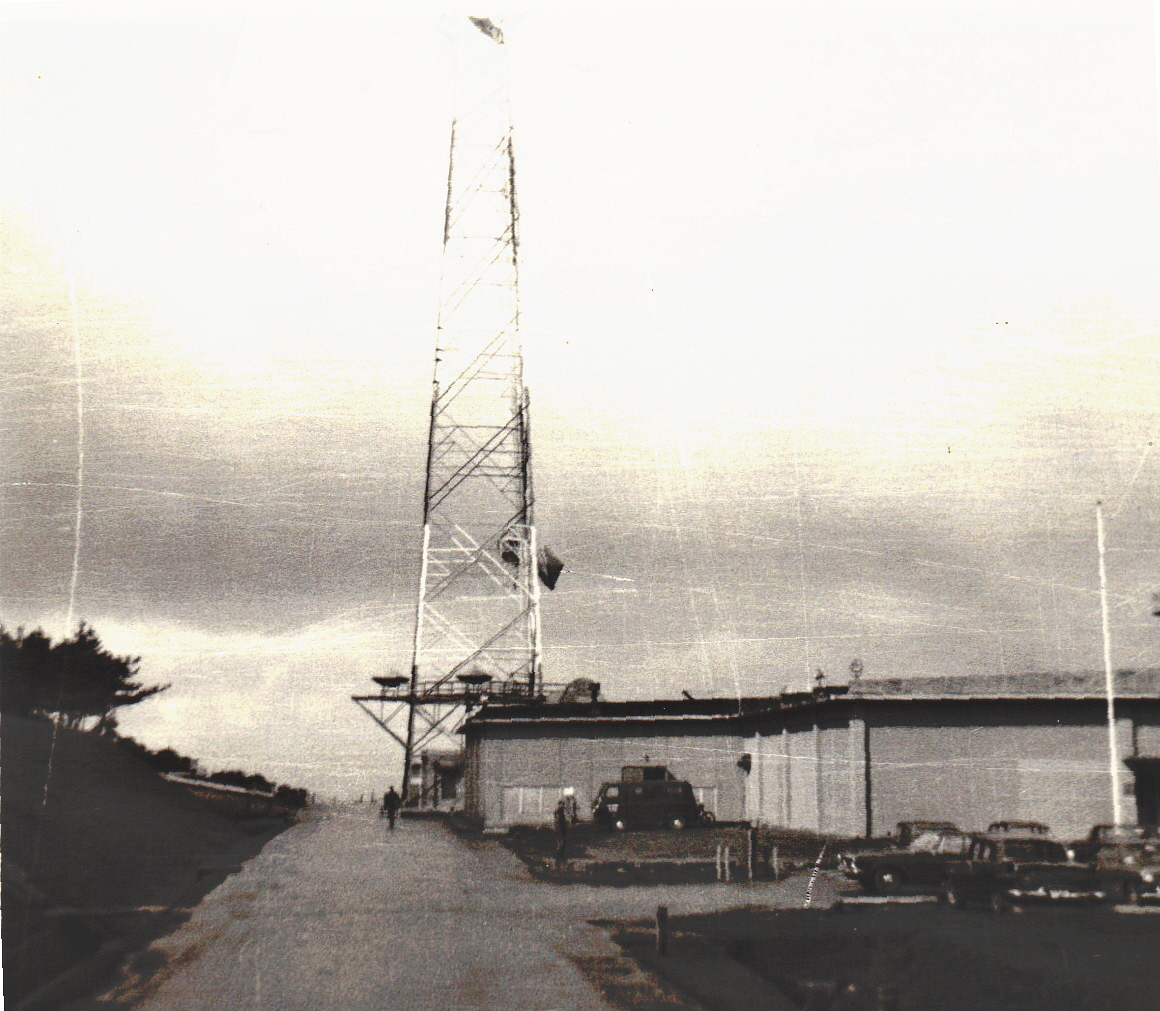
Expand this excellent shot of the MAAG Compound building with the microwave tower to the left. The dish was pointed toward Grass Mountain. Only four people worked the day shift and two at night. 

The military telephone exchange was staffed by ROC locals 24/7. The STRATCOM sign can be seen at the base of the tower.


Looking from a different angle, you can see how compact the building was considering all that was in it. Since Chris was here from 1972-74, you can see how the end of the Vietnam War was also the end of a large military presence in Taipei.


Here is Chris with Mr. Lo, one of the nationals who worked for Stratcom. You can see the letters for Stratcom behind them. Hoops anyone?


Inside the compound is a spirited volletball game between the TME microwavers and the MPs. The outcome is unknown, but the MPs are the tall guys.


Inside, we see some of the microwave equipment. The clock has a large Z for zulu time. Similar equipment can be seen on this blog's 10/21/2010 Gold Mountain posting.


This photo was described as a battery backup for the TME site.


This photo shows a temporary microwave setup to give ability to remove old Collins microwave and replace with a new Motorola.


There is an inside joke here. Chris said the winner was SFC Oshiro, the Site Chief.


A promotion to SP.5 (E-5) is being enjoyed both by Chris and his wife, Fae. By now all the ranks and unit patches were camouflaged.

 His group may have been the last Stratcom presence in Taipei.  Very shortly after Chris' tour was over, the USACC was in charge of communications.

Friday, December 9, 2011

A Funeral In Kaohsiung

You never knew what unique experiences you were going to encounter during your tour of duty in Taiwan.

A former soldier, who has contributed to this blog before, sent some shots he took of a Kaohsiung funeral.


Apparently, the more well-off financially you were at death, the more fancy your funeral would be.

There are also other shots from around the Kaohsiung and Tsoying area.

All pictures were taken and presented for posting by M. Faulkner. 


The funeral procession as seen from a room at the First Hotel in Kaohsiung.


Wreaths stand outside a building. Whether they are to be transported or whether this is their destination isn't known.


This appears to be near the water.


Looking across a lake, you can see some pagodas.


This is some sort of youth athletic event.


Nothing beats a bicycle if you're a kid.


Construction going on here 


A Kaohsiung neighborhood after a storm


A cement factory