USASTRATCOM

This blog was created for USASTRATCOM Long Lines Battalion Army personnel who served in Taiwan during the 1965-72 time frame. Specifically, those who lived and worked in and around Taipei are the target. If you worked at the Grass Mountain or Gold Mountain facilities or anywhere in downtown Taipei, we would like to hear from you. All are welcome to visit and contribute to this blog. Your comments and pictures are encouraged.

Wednesday, June 20, 2012

USASTRATCOM Near Shu Linkou Air Station, 1967-68


The longer this blog continues, the more I'm convinced that there were more Army Signal Corps soldiers stationed throughout Taiwan than I ever imagined. 

We who trained at Fort Gordon, GA were the telephone operators, pole climbers, tape and card pushers, among some of the specialities. 

Do your job and ask no questions unless the need to know arises. That seemed to be the sentiment.

The guys who knew the "big picture" of how communications actually worked in Taiwan were those who trained at Fort Monmouth, NJ. 

They trained as tech controllers and microwave specialists, among the skills. 

Somehow, signals got on and off the island and the Signal Corps was there to do it.  Microwave sites were all over the place. 

Grass Mountain and Seven Star were important links, but nobody yet has written to explain just how all communications were coordinated.

Anyone knowing the complex threads of transmission in Taiwan, please fill us in.

With this post, we have pictures from Mike Aschoff who was a microwave maintenance and repair specialist at a place very near Shu Linkou Air Station. 

He lived initially at the hostel outside the East Compound and was transported to and from work by military drivers. What a commute!.

Mike indicated that the shifts at the center consisted of 3 or 4 workers, but it had to be manned  around the clock.


. 


This is the USASTRATCOM communications center and  tower located very near Shu Linkou. 

Not many soldiers worked there, but it certainly was crucial that it functioned well or we lost our connection. 

Would this place look familiar to the Air Force men who worked at Linkou?


Inside this complex were the machines necessary for microwave signals to be sent and received. 


We did not even think about taking pictures of our teletype equipment even though we may have been given permission. 

As far as I know, nobody took interior shots at Grass Mountain. 

Gary Roske has previously shown interior pictures at Gold Mountain.


From pictures sent from other STRATCOM microwave and tech control specialists, this seems like standard equipment. 


Above, we are looking at Mike's STRATCOM ID badge which was very snazzy  compared to what we bought at the PX.  I believe most Stratcom folks bought them.


The unique part of this picture is the blue badge beneath Mike's.  It belonged to Mike's wife who, after graduating from college, worked for the Chinese Navy. 


Many of us enjoy looking at photos of cars from the 1960s.  This is from the Christmas season of 1967, probably taken from the commissary steps. 


Looking across Chung Shan North Road outside the East Compound is a banner.

It says "HEDSUPPACT TAIPEI." Most of us know it better as the West Compound.

This was Navy terminology. Later it came under the control of USTDC around 1959 according to Kent Mathieu's post on the history of the Air Force in Taiwan.

Check it out by clicking  here and look for HEDSUPPACT on December 7, 1962.


Does anyone know where this is in Taipei?


This photo has to be in Shimending, isn't it?

Tuesday, June 19, 2012

China Post Candids, 1967-68

The China Post was and still is an English language newspaper published in Taiwan.

It can be read daily online at USTDC.blogspot.com. Just scroll down the column on the right.

Mike Aschoff was gracious enough to share some pages from the 1967 and 1968 China Post  candid photos section.


Tuesday, June 12, 2012

Grass Mountain Hostel, Taipei, Taiwan, 1956

Our recent posting about the Taiwan Sugar Corporation and its Yangmingshan building brought several comments.

Kent Mathieu, who runs TaipeiAirStation.blogspot.com, sent a link to a posting he had done on September 10, 2008.

An Army Signal Corps soldier, assigned to MAAG in Taipei, sent Kent some pictures he had taken of his stay at the Grass Mountain Hostel in Yangmingshan.

This posting was familiar to me as I had read all of Kent's and Don Wiggins'  (USTDC.blogspot.com) posts as a prelude to starting the TaipeiSignalArrmy blog in August of 2010.

Since my work station and apartment were both on Grass Mountain, I had taken a great interest in the area during our time there. Now my interest lies even deeper.

So, here are some pictures of Grass Mountain in 1956 from George Marcy. It is fortunate we have them as George and his friend were soon assigned to Kinmen and Matsu, respectively.

The first picture, however, is the CAT plane which brought him to Taipei. The Webmaster at Dawgflight.com and I have developed a place in our hearts as well as our pages of all things CAT.

So, all pictures are courtesy of George Marcy. The entire posting can be viewed by clicking HERE.

Thanks for the reminder, Kent. Funny, but 2008 seems so long ago when reading your and Don's total body of work.


Imagine how young, naive and trusting we were boarding a plane like this and fully expecting it to land on a dime at its destination.


This photo is of some historical significance as it is the only picture of the entrance to the Grass Mountain Hostel  I've ever seen.

Many men lived there during the 1950s. Is this what you remember?

Look carefully and you'll see a guard shack in the distance as well as a banner in Mandarin. The entrance must be directly to the left by the guard house.

The canopy of trees and the graded road certainly show the hostel's isolation.


I don't know if this was the entrance to the hostel itself, or the entrance to the sulphur bath nearby.

It was Hostel #1 when we were around in the late 1960s, but is Hostel #12 here.

Sunday, June 3, 2012

Same Building, Different Decades, Yangmingshan, Taipei, Taiwan

Thanks to LTC Scott Ellinger and fellow Taiwan military bloggers, Don Wiggins and Kent Mathieu, I've received much in the way of pictures and stories that have provided material for postings.

Here, we have a building which has served many purposes and is still functioning as part of a complex of buildings.

Information for part of the history of the sugar industry in Taiwan came from:  taiwanpedia.culture.tw/en/content?ID=3765


Photo courtesy of Scott Ellinger

Japan began its occupation of Taiwan around 1895. Shortly afterward, in 1900,  the Taiwan Sugar Company was established in Tokyo. It was not a monopoly as several other corporations built sugar factories in Taiwan.

By 1923, there were 44 modern sugar factories, and over 100 converted or old-style factories in Taiwan.  Truthfully, there wasn't much competition.

The southern area was the first and most productive sugar producing region. Specifically, the regions near Kaohsiung and Taichung were fertile and also provided access for shipment of this precious commodity.

As WWII ground on, the land used for producing sugar was turned into rice paddies. This eventually led to the decline of sugar as a major export commodity.

The building above was built by the Taiwan Sugar Company in the Yangmingshan area north of Taipei.

When it was constructed is unknown, but notice the automobile which might put this picture in the 1920s, possibly a decade later.  The sulphur bath building is off to the left.


Photo courtesy of Scott Ellinger; USTDC.blogspot.com post 02/21/2012


This 1931 photo of the Taiwan Sugar Company building indicates an outward status quo by the Japanese. It would continue that way until 1945 when WWII ended.

But it wasn't until 1952 that the Japanese relinquished all rights to Taiwanese property. By then, the ROC had become fully entrenched.


Photo courtesy of Stev Pitchford: USTDC posts 05/12/2008, 02/21/2012


Photo courtesy of Stev Pitchford: USTDC.blogspot.com 05/12/2008, 02/21/2012


After WWII, the ROC eventually relocated to Taiwan after the PRC took control of the Chinese mainland.

As a major supporter of the ROC, the U.S..Armed Forces and dependents began to be assigned to Taiwan in large numbers.

The old Sugar Building was converted to barracks for servicemen who lived there from the 1950s until around 1972.

It was also used as a traveler's hostel occasionally. In fact, it was referred to as Hostel #1.


Photo courtesy of Yangmingshan National Park Collection


Photo courtesy of Liangcw-blog

Since 1981, the former Sugar Building/Hostel #1 is part of a multi-building complex known as The Taipei Teachers' In-Service Education Center.

Photo courtesy of Scott Ellinger

Recently, Army LTC Scott Ellinger took a trip to Yangmingshan and shot the above photo in color and matched it, according to distance and angle, to the first picture in this post.

According to Victor W. Cheng's comment, the earliest the botttom picture could have been taken was in the early 1930s.  

Thursday, May 24, 2012

The Church On The Hill

Using Google Earth Street View while putting together the Grass Mountain Community Center post, I ran across this Catholic church on the north side of the hill.

Does anyone know how long it's been there?


Straight up Aifu 2nd Street, following the yellow line is the church, circled in purple.


This overhead view shows the fan-like shape of the roof as well as the space around it.


The approach to the front gate is still on Aifu 2nd Street. Directly to the left are some abandoned BOT "F" houses. 


The church's address is actually No. 2, Huagang Road. Continuing on the road to the left leads to the Chinese Culture University.


Photo by swimming007

This excellent picture shows the Corpus Christi Catholic Church. It has weekly Mass, according to the information  found online.


Well maintained, the church and its side gate are across the street from a parking lot.


Thursday, May 17, 2012

On The South Side Of The Hill


Very close to the Grass Mountain Community Center building is another facility. Its purpose can be defined by this quote:

"Our society must make it right and possible for old people not to fear the young, or be deserted by them, for the test of a civilization is the way it cares for its helpless members."        
 --Pearl S. Buck

South and west of the GMCC is the Taipei Municipal Yang Ming Home For The Disabled.

The approximate 500 residents are those whose mental capabilities are so limited that they otherwise could not live on their own.

This complex wasn't here in 1968, but its history can be read by clicking HERE.


The Grass Mountain Community Center is circled in red. Just west and slightly below it is the residence center circled in blue.


Google Earth Street View shows the approach to the front of the main administration building.

Going in the opposite direction leads to the outskirts of the Chinese Culture University and then becomes another road to Tianmu.


Just a closer look


The gated entrance with the descending road continuing


A bit further with the sidewalk on the right

Photo by Susan Curry


Nearing the complex walls


The name of the institution


This is the end of the road as far as the home for the disabled is concerned.

Continuing on the road to the left will eventually take the rider back to the approach to the GMCC.

Tuesday, May 1, 2012

Grass Mountain Community Center and Teen Club, Taipei, Taiwan

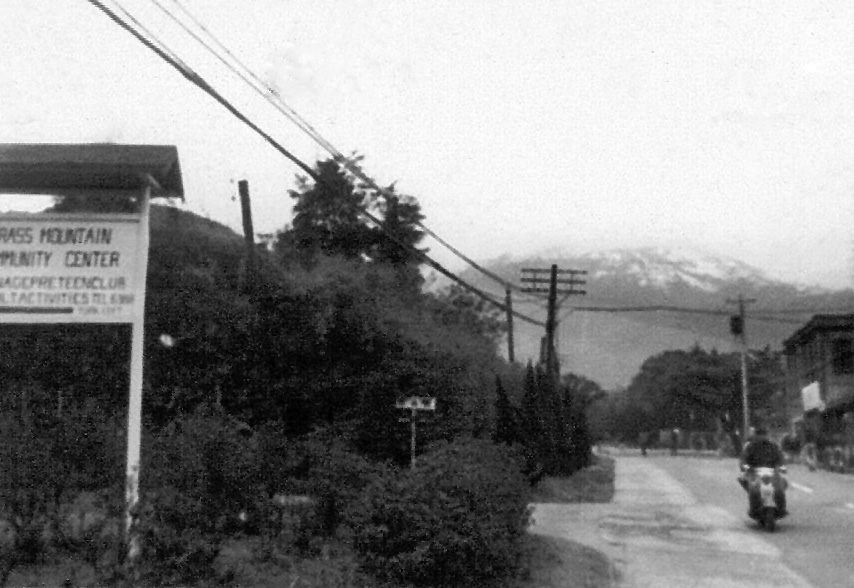
Just one black and white picture of a sign has blossomed into a fulfilled quest. If Larry Barton had only known.

Army LTC Scott Ellinger has been narrowing his search for the Grass Mountain Community Center and Teen Club. In the past his hunches have proven to be pretty much on the money.

In a previous posting, he marked a site where he thought it once stood. Now, its location has been firmly established.

For all of the families who lived in BOT housing, these pictures might look familiar. 

Photo courtesy of Larry Barton

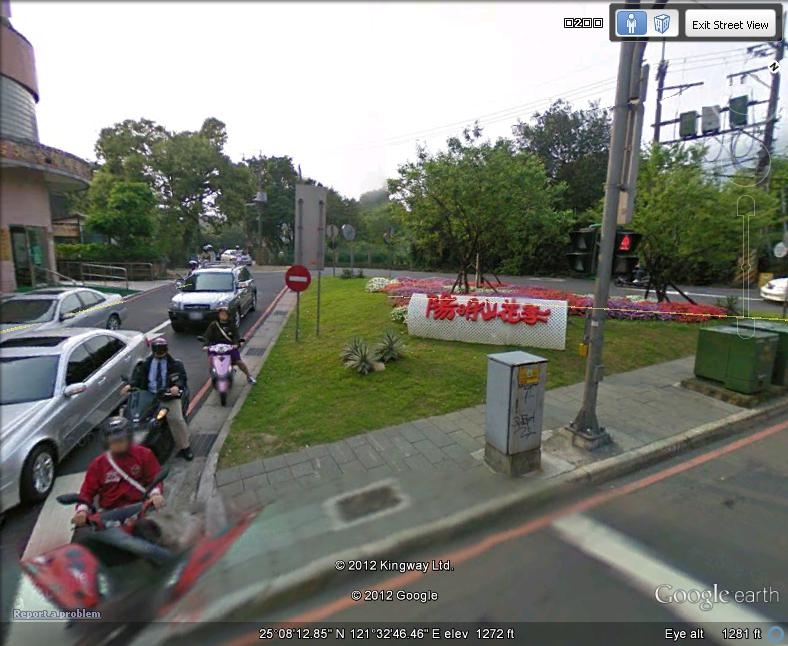
Looking north, the Community Center sign is partially visible on the left (west) side of the road.

Across the road and up a hill was the movie theater and combination snack bar and bowling alley.


Today, a small triangular area is shown. It is just slightly north of the old sign.

The other side of the triangle shows a more direct route to the Teen Club on Kaixuan Road (Sometimes referred to as a Street.). 


The yellow lines show the two entrances to Kaixuan Road, followed by the direct route to the GMCC.


Original PowerPoint slide courtesy of Scott Ellinger

Circled is the community center itself.


This closeup shows not just the two huge additions at either end of the building, but also a swimming pool near the middle.

There is a huge dropoff to the south, down a hill. Others will certainly know what the place looked like in the days of the Korean and Vietnam Wars.


This is just a straight line view down the road to the end of the building.


The road from where the picture was taken is a shortcut to the community center from the F housing area. The street from which this photo was taken is Guotai Street.


To the right of these parked cars is the main entrance. To the left appears to be a guard shack.


Looking straight on, you can imagine how impressive this entrance once was.


With the Chinese Culture University in the background, we are not quite halfway to the end of the community center.

Much of the land around here is leveled as many C and F Housing units were demolished.


With this shot, the deterioration of the building is evident. Either that, or it's in the process of repair. Things change quickly and the date of these pictures might be 2005.

Efforts are being made to persuade the Taiwanese government and the Bank of Taiwan to declare the former C, F, and H housing areas near this building and others to Monument Landmark  status to ensure their preservation.

For more on this click HERE.


Looking back, one can see how wide this building is. Wouldn't you like to see the inside? Maybe not


Near the west end, the place definitely looks shoddy.


Kaixuan Road continues, but the building ends.