USASTRATCOM

This blog was created for USASTRATCOM Long Lines Battalion Army personnel who served in Taiwan during the 1965-72 time frame. Specifically, those who lived and worked in and around Taipei are the target. If you worked at the Grass Mountain or Gold Mountain facilities or anywhere in downtown Taipei, we would like to hear from you. All are welcome to visit and contribute to this blog. Your comments and pictures are encouraged.

Sunday, March 24, 2013

THUMP! August 11, 1969, Taipei, Taiwan

Many of us have just been cruising along in our automobiles when, suddenly, there will be something or someone who makes contact with the front or side of our car.

It happened a couple of times to me as a teenager. Once, I took out a friend's dog as he was running loose when......THUMP!  I called to apologize about killing a dog that was running off-leash since I still felt badly.

My brother had a deer plastered all over his windshield and driver's door after the thing tried to beat traffic on the interstate during the afternoon, but....... THUMP!

With insurance taking the sting away financially, we get over these encounters. However, if you have ever struck a pedestrian, the.......THUMP.......stays with you forever. This happened to me Monday, August 11, 1969.

The date was easy to recall, because my wife had left Taiwan after her year was up on Friday, August 8, 1969.

So, after almost a year of living and working in paradise, I spent the rest of August dealing with the ramifications of a......THUMP!

Sorry for using the letter "I" so much, but this was a very personal experiience and sometimes word substitutes don't capture the mood.


Fortunately, our 1968 Toyota Corolla was built close to the ground and was considered a compact car. It had 1100 cc of screaming 4 cylinder power. 

Still, we had signed a contract in 1968 to sell it before I left the island on September 1, 1969. The laws then did not allow ROC citizens to purchase and import a new automobile.

So, those who could afford it had to pay a 100% sales tax on vehicles that were used. The price of the car alone was simply doubled to satisfy the government.

The Lincoln in front of ours in the above picture went for several thousand dollars as it, and Cadillacs, were the cars of choice for the rich folks. They were almost always painted black and had a venetian blind covering the back window.

Still, after driving our car for a year, we were contracted to sell it for the purchase price of $1400. This was a sweetheart deal for us until.............THUMP!


Picture yourself standing in front of the car, facing the windshield.

Then imagine this vehicle coming at you, brakes locked and screeching, closing in at about 35 mph.

The $100 paid for full-coverage auto insurance then became all-important.
 
Photo by Gary Wilson; Courtesy of TaipeiAirStation.blogsot.com

This certainly appears to be the road we took going down from Grass Mountain to Taipei on that Monday. 
There were 3 other guys in the car with me. We were headed for the Signal Compound to begin processing out.

As I made the turn at the curve, there, about 50 yards ahead of me on the road, was a woman.

She was standing with her back to me, feet on the middle stripe, talking to people on the left side of the road.

It's one of those situations when, in a fraction of a second, you realize that something terrible was about to happen.


Card photo courtesy of Mike Aschoff

Should I floor it and hope she doesn't move, OR, should I blow the horn and hope she stands still or jumps to the left side of the road stripe.

Well, I blew the horn, she looked at me and started to sprint to the other side of the road.

You know how they tell you how much ground you cover at various speeds before even touching the brake?

Slamming on the brakes, THUMP! We hit her at waist level and she was attached to the car as we slid to the side of the road.

At that point, the car stopped and she tumbled to the pavement right in front of the local police station. Getting out of the car, I knew she was dead.

In fact, I was told several times that it would have been better for me legally, if she had died right there.


Card photo courtesy of Mke Aschoff

Well, she didn't die. Her stocky build and short stature must have saved her. I don't know where Mike got the STRATCOM accident card above or the general accident card above it.

I could have used either one. Instead we stood there for about an hour until the MPs showed up. She moaned, we watched. She moaned some more and we watched. Nobody did anything to help her.

Finally, the policeman finished lunch and came out to see what all the fuss was about. After that, a taxi was flagged down and she was loaded into it and, I hoped, was off to a hospital.

Man, I could really have used one of those cards, but I'd never seen one. Neither had anyone else on the hill.

So, I was read my Miranda Rights and remained silent. That particular law had only been around since 1966, but now I began to feel like a criminal.

Only the hood of the car had any major damage as it was caved in, forming a "V" from the THUMP!

So, back to Grass Mountain we went. One of the guys had asked at the scene what I wanted him to tell the MPs.

I suggested that he might try telling the truth. Apparently, that was contrary to his usual method of explanation.


Photo courtesy of Victor W. Cheng via vghtpe.gov.tw

Our NCOIC was already ticked when we left at noon since we were leaving the group short-handed. Now, this!  In other words, "Crum, how could you do this to me?"

Thanks for the support, Sarg. How about coming with me to the hospital. He had no choice.

By now, the lines of communication between us and the military police office in the West Compound was established. I was given her name which was quickly written down.

Then the hospital where she was taken was given to me as well as its location. It was the Veterans General Hospital in Pei Tou on Shi Pei Road.

So, off we went in the car with a slip of paper and a sack of fruit which was considered a showing of peace for her. Someone who knew lived with a local gal told me this.

When arriving, the picture above is how the hospital appeared to me. I just knew that the woman was there, somewhere.


Photo courtesy of Victor W. Cheng, via vghtpe.gov.tw


Finally, the main administrative building was pointed out. In we went, expecting to quickly find her location. A bad day was going to get worse.

Photo courtesy of Victor W. Cheng, via vghtpe.gov.tw

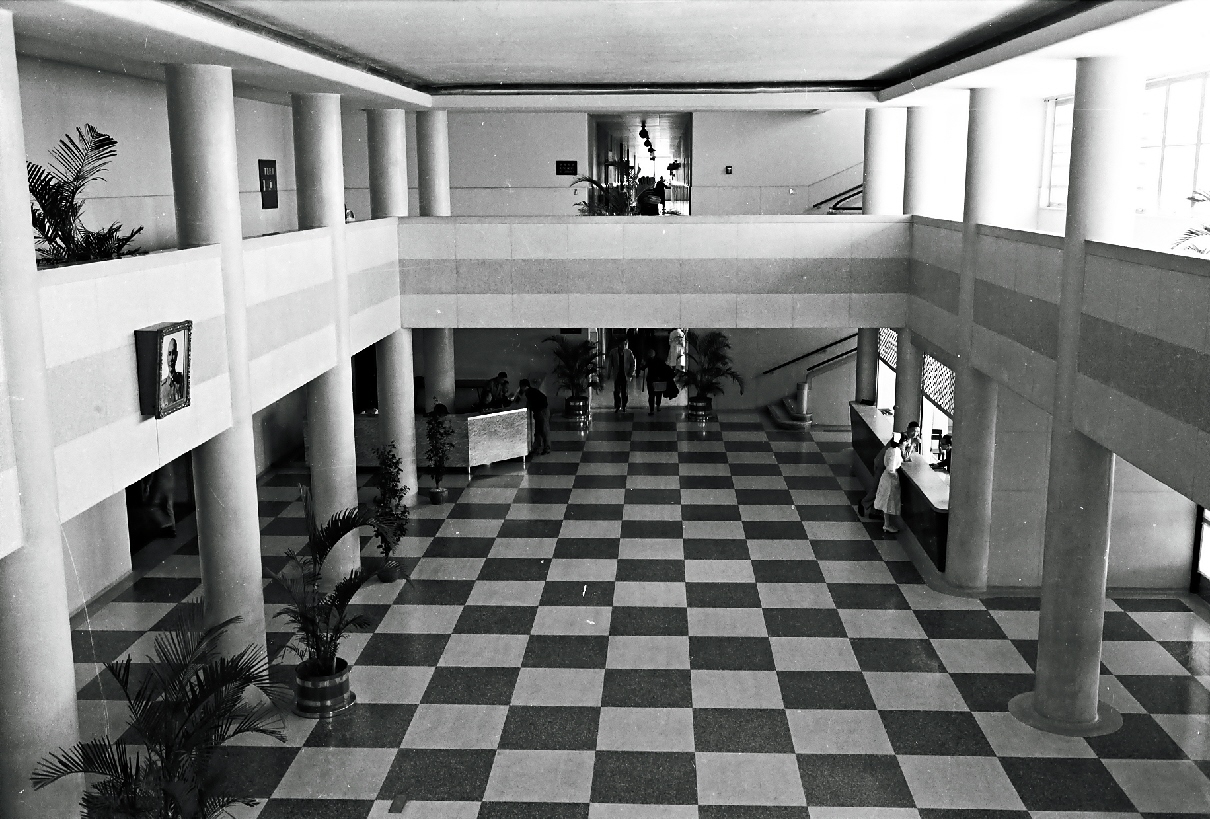
I don't know if the picture above is that of the lobby inside the main administrative building.  I was only in it once, so let's say it was. 

The main thing is that no one seemed to speak English.  I kept waving my little sheet of paper around with the woman's name on it, but it was about 3 p.m. and everyone seemed busy. 

Finally, a doctor who spoke English stopped and read my note.  He then asked if the person was a man or woman. 

That is when I realized that not only did last name come first, but names were sometimes used by both sexes. 

I pantomimed, without trying to be disrespectful that we were looking for a woman.  

After getting that straightened out, we went to the receptionist's desk. She gave us the building number and room where she was..  

Photo courtesy of Victor W. Cheng via vghtpe.gov.tw.

Her room was in one of the eight or so multi-story buildings on the hospital's campus.  I drove slowly around until her building number appeared. 

 I parked the car and entered the building along with the sergeant. 

We were escorted to her room where she lay in her hospital bed, moaning.  A doctor came in and showed me her x-rays, like I was going to read them like a radiologist.

He pointed out 5 fractures of her pelvis and threw in for my knowledge that she may never walk again.  I remembered my Miranda Rights and still remained silent. 

Photo courtesy of Taipics.com

The next morning I went to the West Compound wanting to talk with a JAG Army lawyer at the PMO Office.  Fortunately, he had talked to us about processing out a few days before, so I knew his face and his office.  

I asked why I was read the Miranda Rights and he assured me that it was the law and not to be too upset about it.  After that, I gave my statement to one of the MPs.  

Then I decided to go out to the hospital.  This time she seemed in better spirits until she saw me.  She then began to groan and cry. 

She had a 24 hour nurse which I assumed was due to the fact that I was an American soldier.  That was the last that I saw of her.   


Since it was two weeks before we were to leave the island, I had a lot to do.  First, I contacted the insurance agent south of the East Compound and wrote an accident report. 

I knew we had full coverage and was not concerned about her injuries being covered. 

Getting the car repaired was not a big deal.  The body shop was on the way to the Club 63.  I dropped the car off and some teenager went at the hood with a hammer and a body shaping tool.  

Kent Mathieu, who runs the Taipei Air Station blog, and I compared stories of our car accidents.

We found that both of us had our cars repaired at the same place.  The repairs took about a week which was fortunate as I was due to sell it around the 21st of August.  

Meanwhile, nobody would tell me if it was okay to keep processing out or whether there might be a court proceeding. 

My previous work at the Taipei Station on Grass Mountain once covered an Air Force officer whose car killed a woman when she ran from behind a bus.  

His penalty was converted into a fine in U.S. dollars.  He declined that settlement since he was in no way guilty.  He demanded a trial and was declared innocent.  

As for me, my previous career was in auto insurance which gave me the knowledge of what to do for myself.  I decided to visit the claims department at Taiwan Fire and Marine.   


I took a taxi down to the main office, met the Claims Supervisor and we began to talk about insurance. 

I mentioned the name of the company I had been with before being drafted and he began to talk about burglary and theft losses (-110%).  I listened politely. Then, he pulled my file.

Finally, I signed a Subrogation Agreement which gave T. F. and M. the right to settle the claim on my behalf.  My responsibilities for the accident victim were over legally. 

The car was fixed in time and the sale was completed in downtown Taipei around the 21st of August.  The THUMP! turned out to have been one of contributory negligence. Simply put, we both were at fault for some portions of the collision.

Later, I found that 2 points had been assessed to my Chinese driver's license since I had been speeding.  She received an admonition since she did not cross the road at a designated marked zone.  Case closed.


This is the new Veterans General Hospital as it appears today.  It has been rebuilt, but is still on the same road in the Beitou District. 


This might be near the original front entrance of the old hospital

As you can see, this is an up-to-date facility.

Wednesday, March 13, 2013

Taiwan Tourist, Peter Arnett, 1969

We may have kept this article as proof to family and friends that Taiwan was being discovered as an emerging tourist destination.  

 Particularly, we must have sent this article first to our parents to assure them that we were not fending for ourselves in the middle of a jungle. 


Peter Arnett was working for the Associated Press during the Vietnam War and, for some reason, wrote this Pacific Stars and Stripes review of the emerging Taiwan. 

He was awarded the Pulitzer Prize in 1966 for International Reporting. 


Mr. Arnett, as he appears today, was most widely viewed when he was a correspondent for CNN.  Today he teaches in China (PRC). 

Saturday, March 2, 2013

Once An Officer, Always A Gentleman

A few months ago, a request was made to see if there was someone who knew how all the messages left and entered Taiwan. 

 When we were working in the teletype punched paper tape relay, we thought that everything entering and leaving Taiwan had to go through either the DCS major relay or NARC relay using 80 column computer cards at Grass Mountain. 

Our messages were sent and received from Clark AFB in the Philippines.

Well, it didn't take long for Tech Controllers and Microwave Techs to start explaining their jobs during the Vietnam War.  The men at USACC know the technology, but not all were around from 1965-72.

It became apparent that some messages were leaving the island and arriving in Taiwan by some other method than through our site at Seven Star. 

Then, a former Army officer sent a detailed "technical puzzle" which included the "whos, whys, whens and hows."  This cleared the way for an explanation of some of his duties. 

So, with former 2nd Lieutenant Robert W. Marwin's permission, I will attempt to copy many of his explanations.  

Our thanks to Bob for his time and effort. Now, if more of you men checked in with pictures and stories, who knows . . .

________________________________

I am Bob Marwin and I got your link through a friend  I had in Taiwan, Dennis Mitcheltree.  I was the Page Communications System Engineer for the Phil-Tai-Oki System from around 1968 to 1970.  Harry Oi was the Civilian Contract Administrator at Grass Mountain.  Paul Rosamond was the Page Site Manager at Seven Star. 

The tropo system ran down-island to Kaohsiung, then to the Philippines at Clark Air Force Base, and then north to Okinawa at Fort Buckner.  It was a quad diversity system running 10 kW max on four transmitters, and transmitting around 950 MHz. 

Seven Star was linked to Grass Mountain via a Collins Radio Corporation commercial microwave; 1 W at 7.2 GHz.  There was a passive reflector (2 Andrews microwave dishes back-to-back) on a 30 foot concrete tower 1/2 mile uphill from Seven Star re-transmitting to the dish on a 100 foot tower at Grass Mountain. 

The tropo system carried 12 voice channels plus order wire on a commercial Lenkurt multiplexer. 


Bob lived in Taipei in a rental second floor apartment.  He still remembers the address:  #12, Alley #1, Lane  #259  Min Chuan East Road.  He had a roommate, Carl Weidman, and seemed to have a very active social life when not working. 


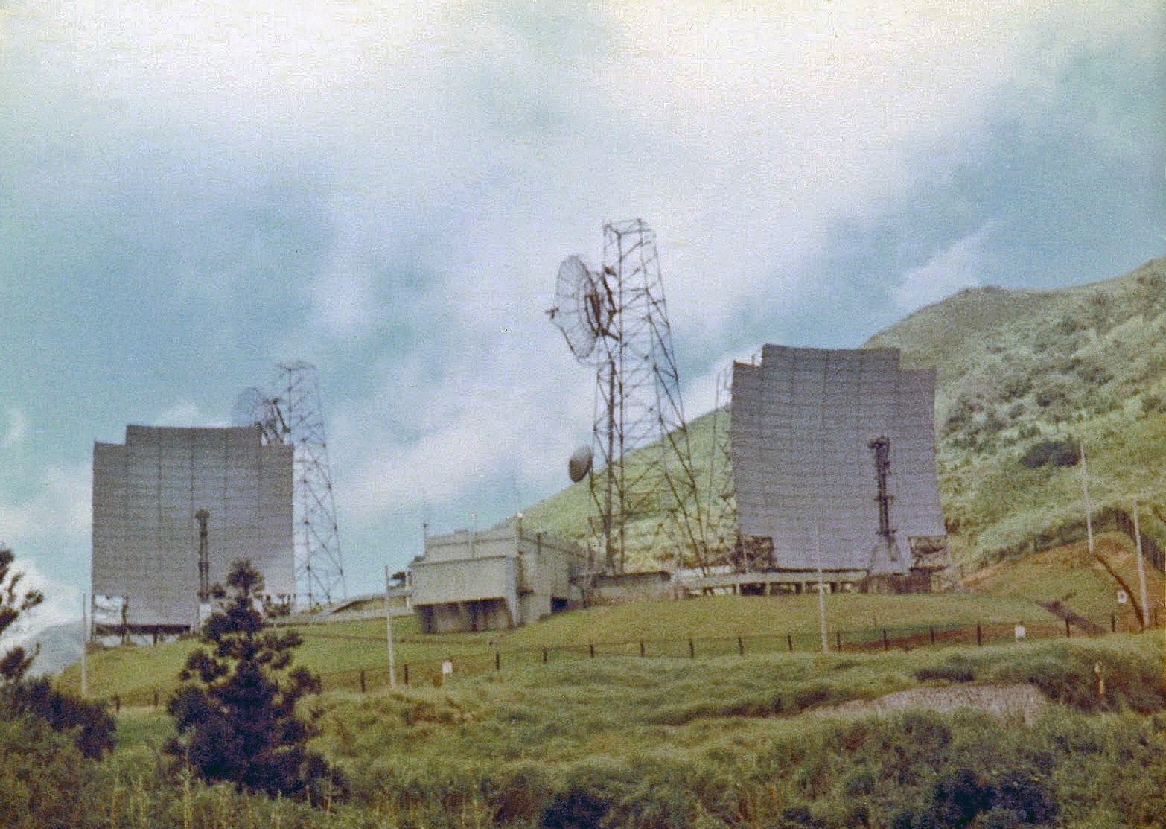
The two big drive-in movie screen tropo antennas are shooting troposcatter signals to Okinawa.  The microwave dish (tall dish in the middle) shot a signal to a passive repeater at Grass Mountain.

The two 20 foot dishes on the 100 foot towers are shooting troposcatter signals down-island to Okinawa.

There was a passive reflector (2 Andrews microwave dishes back-to-back) on a 30 foot concrete tower 1/2 mile uphill from Seven Star re-transmitting to the dish on a 100 foot tower at Grass Mountain.
 
I'm quite sure that the two large white radomes ware air traffic radars, a search and a height finder. 

I climbed the 100 foot tower once at Grass Mountain to do an antenna alignment. Carried a Simpson VOM with 100-200 feet of field wire connected to the Microwave AGC's DC output.

I also climbed the passive back-to-back microwave repeater at Seven Star several times to pump desiccated air into the connecting waveguide.  We had a typhoon blow down one of the 60 foot antennas on the down-island link. The other antenna was hanging by one bolt. 

Paul Rosamond and I climbed the tower in 50-60 knots of wind to tie the antenna on with dock lines.  Two Page riggers flew in the next day from the Philippines to repair the one antenna and repair and re-hang the other one. 
_____________________________

For those of us who are technically challenged, I hope that Bob's formal and informal explanations give you a better understanding of how complicated communications were in Taiwan.  We covered some of this before in a previous post. To see it, click HERE.

Bob related many other activities in which he took part.  Unfortunately, this is a G rated blog and that automatically censors some content.  Let's just say this:  If any of you are hunters or carpenters you will understand what the terms moose and hammer meant during those times. 

There's just one more facinating bit of Bob's e-mail. There was an Air America (CIA) air base at Tainan.  Another base was near Pingtung, in southern Taiwan as well.

Both of these bases were connected to Kaohsiung by microwave links of 20 to 25 miles. Both of these bases, missions and  locations have been verified.
Map from U. S. Army Map Service, Corps of Engineers

Ths map, from 1958, shows the geographical relationship among the bases at Pingtung, Tainan and Kaohsiung (Tsoying).

Friday, February 22, 2013

The Tropic Of Cancer, Taiwan

One of the frustrating features of blogging is the location of the posts.  Each post comes after the previous post until many are buried and begin collecting cyber dust.

For instance, this post is the 12th and last publishing of a series done with the photos taken by Tom Jones in 1957-58. 

After receiving Tom's permission, I picked groups of his pictures and tried to tie them together.

All of the photos not wanted were left to others, including Kent Mathieu of taipeiairstation.blogspot.com who comprised a solid journey Tom took through Matsu.

So, thank you, Tom,  for all of the wonderful pictures. If any of you would like to see the previous 11, or any other post,  just click "Older Posts" at the bottom of each page.

Our last posting in this series is about the Tropic of Cancer, an imaginary line, which passes through Taiwan.

Kent Mathieu and friends have been to the monument in Hualien County. To read Kent's post, click HERE.

With a flat world, the Tropic of Cancer location is indicated by the red line.

As it passes through Taiwan in a couple of locations, tourist attractions have been erected. About the lower 1/3 of Taiwan is considered to be tropical.

In the United States, the line passes through the Bermudas, but doesn't touch Florida. So, Miami is just a few miles north and is actually not considered officially tropical.

Cuba is just south of the line in the Florida Straits. So, Havana is considered to be in the tropics.

Out in the Pacific, the line comes close to Necker Island, northwest of Honolulu by over 400 miles. That puts the state of Hawaii firmly into the tropics.

South of the Tropic of Cancer is the Equator. South of the Equator is the corresponding area of the tropics in the southern hemisphere called the Tropic of Capricorn.

As indicated, the Tropic of Cancer coordinates put it out in the middle of some field, just as it was in 1958.
Photo courtesy of Tom Jones

Here is a picture of the Chiayi City square. The picture of President Chiang is clearly visible. As with the case of other villages, this area is now heavily populated.
Photo courtesy of Tom Jones

So, in 1958, Tom walked outside Chiayi City and took this picture. Later, the monument was moved when a railroad was built, but it is still in a township in Chiayi County.
Photo by Bernard Gagnon
Photo courtesy of Taipics.com

This plaque at the base of a monument gives the coordinates for the original monument which appear to be different to those used at the beginning of this post.

The Tropic of Cancer actually shifts positions as the years  pass. These other monuments add to the park's attractions.

What looks somewhat like a flying saucer is a very new addition to the Chiayi Monument Park. It attracts tourists and students.

This Tropic of Cancer monument is part of the Hualien County Park
Map from World Atlas

From top to bottom we have The Arctic Circle, The Tropic of Cancer, The Equator, The Tropic of Capricorn and The Antarctic Circle. These are major measurements for latitudes.

The Prime Meridian splits the world in half at 0 degrees longitude. It passes through Greenwich, England which gives us the world standard as to time.

Zulu time is, therefore, always the time it is in Greenwich, England which also goes by GMT or Greenwich Mean Time.

Not surprisingly, because of the earth's uneven rotation, all lines of longitude and latitude are not always exactly the same.

Monday, February 11, 2013

Two-Way Traffic On A One Lane Road

Blasting through granite and other stone was sometimes a necessary part of initial road construction throughout Taiwan. 

Tom Jones came across a now-famous road called the Suhua Highway (Provincial Highway 9).  It is called by many as the most beautiful highway in Taiwan.

Today it's about 73 miles long (118 km). The Japanese built it and it was open for traffic in 1932. However, not all of it was 2-lane.

The northern part was one lane only and getting from point A to B was tricky. Cars traveled in bunches of 6, and pulled off the road onto areas where they could wave to cars coming the other way.

The entire road was widened in the late 1980s into 1990. Michael Turton has a wonderful article on the highway as it looks today. To read the text and see the photos, click HERE. 


East and south of Keelung is the beginning of Suhua Highway in Suao Township.


Some 73 miles later is the southern terminus in Hualien City.
                                          
Photo courtesy of Tom Jones

For many of us who lived in Taiwan in the 1950s and 1960s, the site of men actually constructing and paving roads was not unusual.

This picture was taken in Matsu, but could easily have been in almost any other province of Taiwan.

Photo courtesy of Tom Jones

Look to the immediate left of this picture and notice the footpath leading up from the road. Made in Taiwan by Taiwanese

Photo courtesy of Tom Jones

One of Tom's best pictures, the highway, with its single lane, makes its way around the bend.

Our apartment in Yangmingshan had clouds blow by occasionally, but this system seems stationary on this mountain.


Photo courtesy of Tom Jones

Look closely and you'll see a car in the distance. This may have been an area to pull off to allow opposing traffic to pass.


Photo courtesy of Tom Jones

This section of the gravel-covered road had a concrete barrier which was unusual.

Photo courtesy of Tom Jones

Whatever the sign indicates, let's hope it says " STOP!" With the power lines overhead and a tunnel in the distance, it looks similar to many other pictures.

Photo courtesy of Tom Jones

Years later, at approximately the same site with the tunnel, Jeff Wang took this picture of an abandoned section of the old road. Just compare it with the photo above.


Photo courtesy of Tom Jones

There are some pictures that we take that mean so much more than just a still shot. This young Taiwanese aboriginal woman stands proudly in front of her earthen hut.

Isolated for so many centuries, these people were a reason why the Japanese built the Suhua Highway. To me, she looks very dignified as she pauses from her chores.

Photo courtesy of Tom Jones

In her native attire, she poses again for another picture. Taken over 50 years ago, don't you wonder what this area looks like now.  It could be in one of many places in Taiwan.

As for the native Taiwanese woman, here in her flip-flops, what became of her and her family..
Photo by Fred Hsu 2009

The Suhua Highway is still prone to mudslides. Heavy winds and rain can saturate most any steep surface with a soft underground.

This happened to us once at Grass Mountain. The main road going to our work station was blocked for a week.