USASTRATCOM

This blog was created for USASTRATCOM Long Lines Battalion Army personnel who served in Taiwan during the 1965-72 time frame. Specifically, those who lived and worked in and around Taipei are the target. If you worked at the Grass Mountain or Gold Mountain facilities or anywhere in downtown Taipei, we would like to hear from you. All are welcome to visit and contribute to this blog. Your comments and pictures are encouraged.

Wednesday, July 27, 2011

Taiwan High Speed Rail

Each time a post is compiled, my mind asks itself if the guys with whom I served would want to see this stuff if they accidentally found this blog.

Of course the answer is yes since you otherwise wouldn't be reading this. Put another way, what about Taiwan today just might be interesting to a group of semi-old men?

I'd want to know all about where we worked, lived and hung out and how it was and how it changed.

That's why this posting is about the high speed rail system. Couple it with Taipei's MRT, and here is a country far ahead of most others in its view of the future.

Thanks to billions of dollars and Japanese technology, over 200 miles of track accomodates trains going over 180 mph. To see it in action, click HERE.


Here's the THSR logo


Running officially since the beginning of 2007, the THSR has some beautiful stations along its entire route.

This was a test run in 2006. Much of the system is elevated. Each train has 12 cars.

Loading and unloading is convenient.

This may be the Taoyuan Station.


The inside of a passenger car


Is this the Tainan Station?


Looking at the Tainan Station grounds


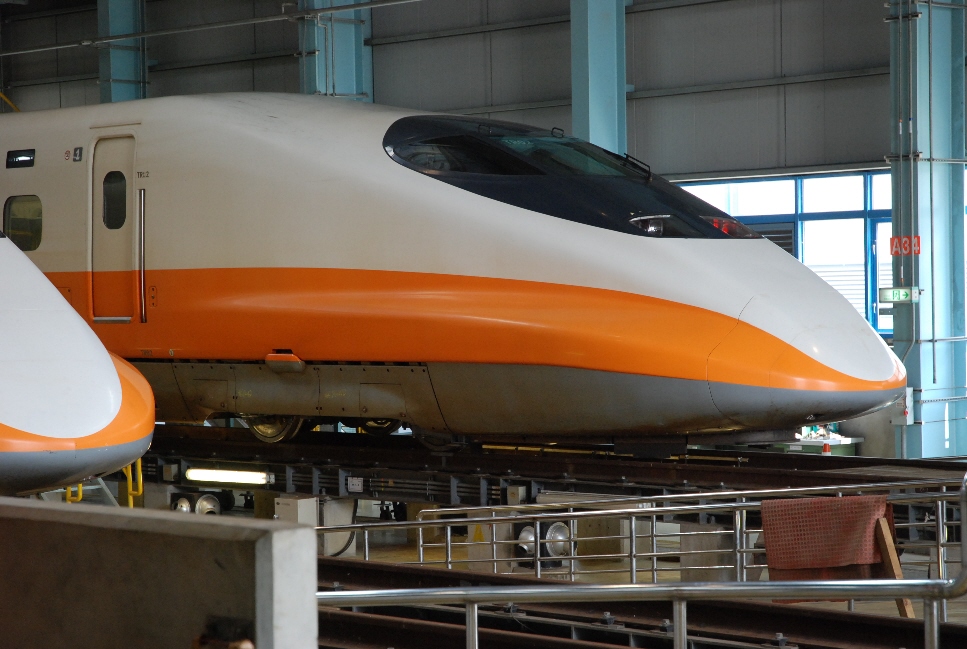
Maintenance is always nearby.


It won't just be a lube, oil and a filter!


Back and running again

Wednesday, July 20, 2011

Airlines In Taiwan (Updated)

This isn't meant to be a comprehensive list. Its purpose is merely to show how Taiwan has changed over the decades regarding air traffic. Some of these carriers may even be defunct.

A new international airport  has been built. Taipei's SongShan Airport is still operating. Some others  have expanded and modernized.

All are in the process of carrying passengers and freight to, from, and within Taiwan.

The planes have changed and some are quite new. Boing and Airbus dominate.


The major change, of course, was the opening of Taoyuan International Airport in 1979. Originally named after Chiang Kai-shek, its present name was instituted in 2006.

With two terminals and a third on the way, TPE relieved the load on the downtown SongShan Airport. TSA still operates and is the preferred destination for many businessmen.


China Airlines now has its hub at Taoyuan International. The tail design has changed.


Founded in 1989, E V A Airways is privately owned and has its hub at Taoyuan International.

It's the second largest Taiwanese airline behind China Airlines.


Uni Air is a subsidiary of E V A Airways. It operates from Kaohsiung.


TransAsia Airways is relative small and has its hub at Taipei SongShan Airport. It is a Taiwanese airline.

Far Eastern Air Transport has recently emerged from bankruptcy.

Its headquarters is at Taipei SongShan Airport with its fleet of ten planes.

This airline may be defunct as Mandarin Airlines has taken over its routes.


Owned by China Airlines, Mandarin Airlines flies from Taipei SongShan and Taichung Airports.

It flies mostly domestic flights, but shares the Taichung airport with CCK, the famous Taiwanese military airport. 

Those of us around during the Vietnam War recognize CCK as one of the major recipients of messages from the Grass Mountain tape relay.


Still a major carrier in Southeast Asia, Japan Airlines might be departing Kaohsiung International in this shot.


The huge Cathay Pacific Airlines is still based in Hong Kong.


Dragonair is a subsidiary of Cathay Pacific.
Doesn't it have the coolest paint job?

 A unit of Delta Airlines since 2008, Northwest Airlines still flies to Taiwan.

Thursday, July 14, 2011

Airlines Serving Taipei During The Late 1960s

There are lists for just about everything. You'll see in this post some of the airlines which had offices in Taipei during the 1967-69 time period.

Some are now defunct, but many live on. The one thing in common: Taipei International Airport. You can see my baggage tag on the right side of this page.


Our scrapbook had to be checked to make sure this picture is in it. Funny how often picture locations were so similar although taken years apart.


The red blob to the left is the approximate location of the old East Compound. The airport  runway is shown directly east of it

When some of those planes were making their landing approach, it seemed as though the wheels might hit you in the head.

Not only were they loud, but they interrupted quite often what was going on such as a softball game or sleep at the hostel. 

Photo courtesy of Taipics.com


CAT Airlines had a short but colorful lifespan.

Created during the early 1950s, it was eventually taken over by Air America, the airline group of our CIA during the Vietnam War.

Its existence ended abruptly after a  February, 1968 crash of a Boeing 727 near Taipei.

There were two American pilots. Both survived, but 22 others died, including the wife of one of the pilots.

To read some declassified documents about Air America, click HERE.


Either landing or departing, this is the same plane shown in the previous photo.

Poster courtesy of Taipics.com


We had been following the path of a typhoon the week my wife was leaving Taiwan in the middle of August,1969.

Final plans were made at the Northwest Orient office on the northeast corner of of Chung Shan/Min Chuan intersection.. 

Surprisingly, she ended up leaving Taipei International on a Cathay Pacific jet, bound for Tokyo.

With no overhead compartments and a shiny metal floor, it was pretty basic. Carry-on luggage was sliding all over the place during turbulence.  


A year earlier, I went to the airport to pick her up. Two JAL flights landed, but neither had my wife on them.

The folks at the counter didn't have her on the flight list either. Little did I know she was in Anchorage, Alaska as the NWO plane she was on had engine problems.


China Airlines was the second airline to show the ROC flag on its tail.


For many service people and their families, NWO was the airline which brought them to and took them away from Taiwan.
Poster courtesy of Taipics.com


Airlines and locations in Taipei


Tuesday, July 5, 2011

An Explosive Time On The Cheap

After writing about the 4th of July in Taipei, I thought about the summer of 1957. Not all cities or villages can afford celebrations with huge fireworks demonstrations.

That was the situation we found ourselves in as firecrackers, cherry bombs and M-80s were being exploded, with some planned fireworks for the evening.

Fortunately, we ran into a visitor our age who was entertaining himself with booming success.

All he had was an old metal Drano can with the metal lid that popped on and off.

Oh, and he had gone to a drugstore and bought calcium carbide which was plentiful and cheap.


This container is similar to the old Drano cans. Just punch a few holes in the bottom with small nails and your cannon is ready.


Here, you see a now hard-to-find bottle with the calcium carbide crystals.


We shook a couple of carbide chunks into the Drano can. Now, calcium carbide reacts to water, so the next steps came very quickly.

First, spit on the chips at the bottom of the can. Wait for fumes to form. Then pop on the metal top. Lay the can on a tree stump or rock and hold a match to the holes at the bottom. 

A giant BOOM blew the top off the can and sent it flying. It was great fun and we repeated the drill several times. Then the kid held the can like a bazooka near his ear and my friend lit it.

The guy's ear went deaf immediately. We stayed around until he could hear, but that was the end of our carbide days.


Today, you can still buy a carbide cannon and ammunition, but to see a less expensive method of explosion with a homemade PVC cannon, click HERE. Or, make your own like THIS.

Saturday, July 2, 2011

July 4, 1969 Celebration

You haven't experienced a really great July 4th celebration unless you are in the armed forces and live overseas.

Independence Day has a deeper meaning when you are a minority in a foreign country.

For a considerable length of time, AFNT advertised the terrific fireworks that would be exploded at the Taipei American School on that evening of the 4th.

We showed up along with our friend who brought his camera and a tripod. He was tinkering with f-stops and shutter speeds to get pictures of the fireworks as they exploded.

We've never seen so many rockets explode in one evening. There was a constant thump when the rockets were ignited, followed by the beautiful explosions above. (Ahhhhhh!)

It had to have gone on for at least an hour straight.


Pacific Stars and Stripes covered planned festivities throughout the island.


After awhile, many people just lay on the ground and looked up.

For some fireworks, just click HERE.


Earlier, our neighbor thought it would be a great idea if he spliced a few rolls of firecrackers together.

Then the contraption was hung from the third floor of his apartment building on down to near the ground.

After the top row was lit, the explosions continued down the side of the building.

Black gunpowder stains remained on the building when we left the island.

Image courtesy of Taipics.com

There is a real irony here, of course. After WWII, products made in Japan and sold in the United States were often the butt of jokes.

Something similar in nature could have been said about China. As kids, we suspected that China was great at making firecrackers.

Anything else? Not that we knew. The ignorant bliss of childhood.